Potty Talk: The Real Scoop on Poop

Kim Flores • November 8, 2024

Your feces can reveal a surprising amount about your overall health, acting as a daily check-up on how your body is functioning.


From color and consistency to frequency, each aspect provides clues about your diet, digestion, and potential health issues. Paying attention to these details can help you spot early signs of imbalance and make informed choices for your well-being.
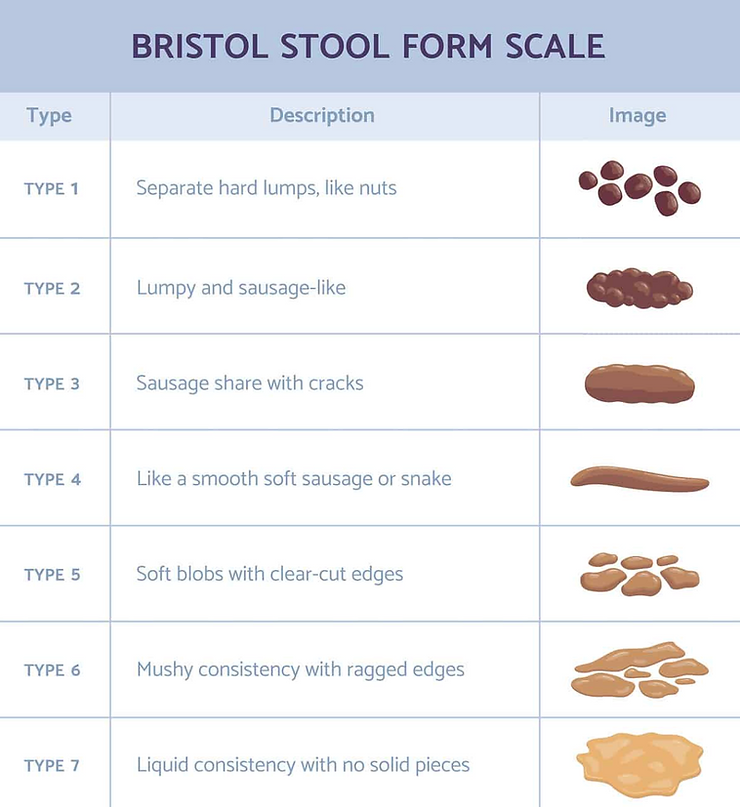
Illustration of the Bristol Stool Form Scale, showing seven stool types with descriptions

First, lets take a look at what some of the main indicators are of healthy stool:


Color

Healthy stool is typically going to be brown due to the presence of bile, which is produced in the liver. Variations in brown can occur, but other colors might indicate issues (e.g., black or tarry stools could indicate bleeding in the upper gastrointestinal tract, while white or clay-colored stools might suggest a bile duct obstruction).

Consistency

The ideal stool consistency is similar to that of a banana: soft and formed but not too hard or too loose. The Bristol Stool Chart (shown above) categorizes stool into seven types, with Type 3 (like a sausage but with cracks on its surface) and Type 4 (like a sausage or snake, smooth and soft) being the most typical for healthy individuals.

Illustration of the Bristol Stool Form Scale, showing seven stool types with descriptions

First, lets take a look at what some of the main indicators are of healthy stool:


Color

Healthy stool is typically going to be brown due to the presence of bile, which is produced in the liver. Variations in brown can occur, but other colors might indicate issues (e.g., black or tarry stools could indicate bleeding in the upper gastrointestinal tract, while white or clay-colored stools might suggest a bile duct obstruction).

Consistency

The ideal stool consistency is similar to that of a banana: soft and formed but not too hard or too loose. The Bristol Stool Chart (shown above) categorizes stool into seven types, with Type 3 (like a sausage but with cracks on its surface) and Type 4 (like a sausage or snake, smooth and soft) being the most typical for healthy individuals.

Shape

Healthy stools are generally log-shaped and passed in one piece or a few smaller pieces. Pellet-like stools can indicate constipation, while very loose or watery stools can indicate diarrhea.


Frequency

A healthy bowel movement can vary widely among individuals. Typically, anywhere from three times a day to three times a week is considered normal, as long as the individual does not experience discomfort. It is important for everyone to know what their baseline frequency is.


Ease of Passage

Healthy stools should be passed without straining, pain, or discomfort.


Smell

While stool naturally has an unpleasant odor, particularly foul-smelling stools might indicate malabsorption or an infection.


Content

Visible mucus in stool might indicate inflammation of the intestines. Blood in stool, whether bright red or dark and tarry, should be promptly evaluated by a healthcare provider. If there is visible undigested food (aside from certain foods like corn that do not break down) this could be a clue that the intestines are not breaking down and absorbing food appropriately.


"People say love is the best feeling. But I think finding a toilet when you have diarrhea is better."


Don't forget to check your stool!


Your bowel movements can give you so much insight to your health so don't be afraid to look! If you find yourself with any of the abnormal signs that we discussed, be sure to check in with your healthcare provider.


Leg with visible spider veins, touched by two hands.
By Monica McKitterick December 22, 2025
Learn six key facts about spider vein treatment, including causes, options, recovery, and insurance coverage. Learn why treatment might be right for you.
Woman sitting on a bed, holding a baby, looking sad.
By Monica McKitterick December 5, 2025
Stay-at-home mom depression is real, but so is recovery. Explore 10 compassionate tips to start feeling better today. Read the full guide now.
Doctor smiling at a couple seated at a desk; doctor's office setting with a clipboard.
By Monica McKitterick November 28, 2025
Learn 7 reasons why families choose Direct Primary Care: affordable, easy-to-access healthcare with no insurance hassles or surprise costs.
Syringe injecting clear liquid from a vial with a metal cap, on blue background.
By Monica McKitterick November 12, 2025
Learn the benefits of vitamin injections, including increased energy, better sleep, stronger immunity, healthier skin, and support for weight management.
Doctor and patient reviewing paperwork, doctor smiling, indoors.
By Monica McKitterick October 16, 2025
Learn 5 ways direct primary care can help with testosterone therapy, including Cedar Park, Leander & North Austin. Take the first step toward better health.
Red heart, family figurines, and stethoscope on a wooden table, symbolizing healthcare.
By Monica McKitterick September 19, 2025
Find 8 affordable health insurance alternatives in the USA, including local options in Cedar Park, Leander, and Round Rock. Protect your health today.
Calculator, stethoscope, and red heart on an EKG graph, symbolizing healthcare costs.
By Monica McKitterick September 2, 2025
Take advantage of open enrollment with Direct Primary Care. Discover how it saves money and how your HSA can cover your care easily.
Doctor in white coat holding clipboard, listening attentively. Stethoscope around neck.
By Monica McKitterick August 15, 2025
Understand why primary care providers can’t address every health issue at once. Serving Cedar Park & North Austin. Take charge of your health today.
Hand putting coin into pink piggy bank on wooden surface.
By Monica McKitterick July 17, 2025
Save on medical bills with 7 easy tips that families trust. Make healthcare simpler and more affordable for you and your loved ones.
young adult man looking down at his feet while presumably in a therapy session
By Monica McKitterick June 20, 2025
Supporting minority mental health starts with awareness. Learn key steps to care for yourself and help others thrive.